AIRTEL ICMS
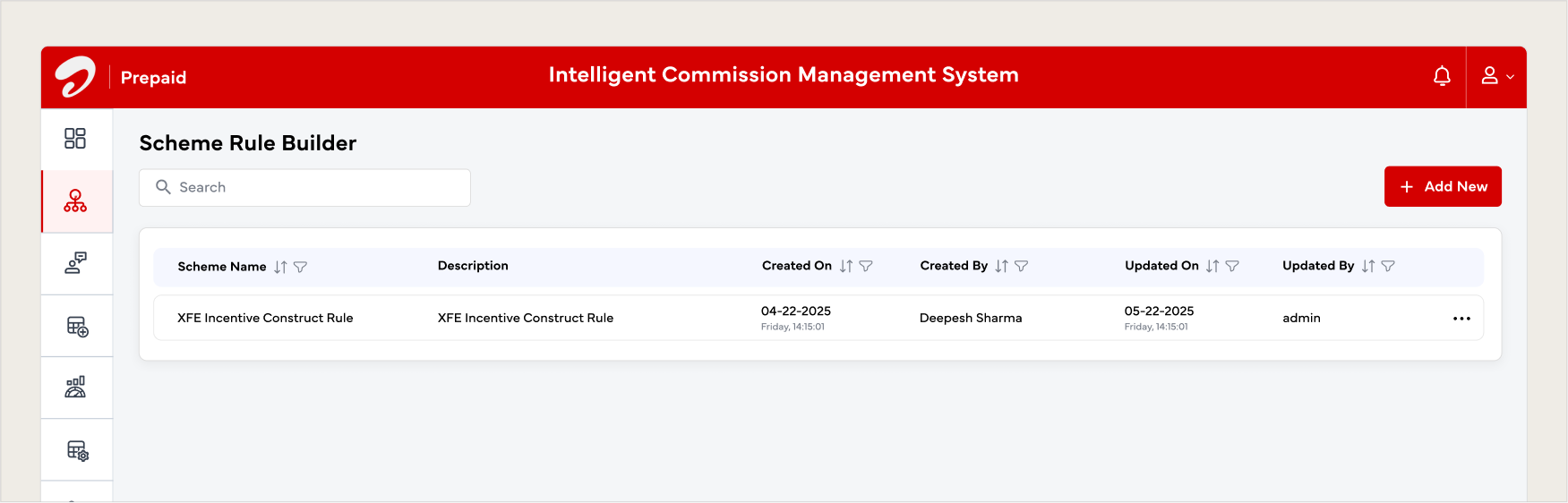
Beyond Dashboards: Fixing a Month-End Operational Bottleneck.
Every month, Airtel’s operations team faced a high-stakes deadline. They had to calculate, verify, and disburse commissions for a rapidly growing network of contractors within a strict 5–7 day window.
The existing setup wasn't broken because of delayed payouts—it was failing under the sheer weight of manual overhead. Teams relied on massive Excel workbooks loaded with complex nested formulas that were constantly copied, modified, and emailed around for management sign-offs.
Excel Overload
Operations teams customized tabular formulas manually in localized spreadsheets, creating extreme version-control risks and formula errors.
Email Dependency
Approvals relied on back-and-forth email chains across management levels, offering zero audit transparency or status visibility.
The Real Mandate
Airtel didn't need a consumer redesign. They needed an automated internal workflow engine that removed human dependencies while retaining formula flexibility.
We didn't just build screens. We productized business logic into reusable, automated configuration engines.
The 4-Step Scheme Creation Engine
Re-architecting Airtel’s operational workflow from fragmented spreadsheet entry into a progressive, four-stage logic engine.
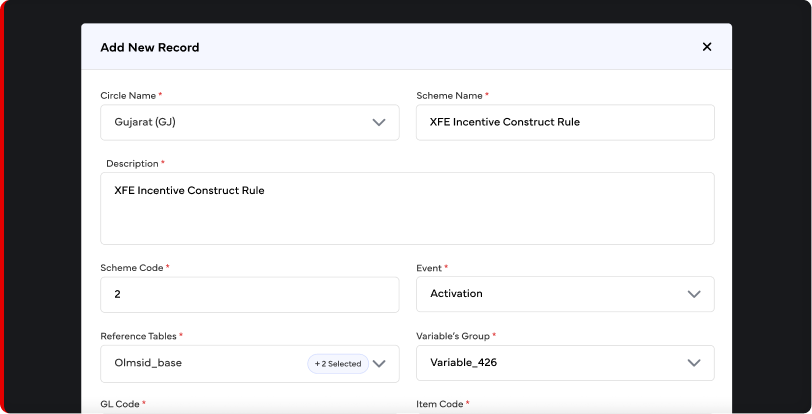
Operators manually entered operational regional codes, product SKUs, and GL account maps into unstandardized Excel columns. Inconsistent naming conventions caused weekly ledger reconciliation failures with central finance.
Enforced a strict taxonomy ingestion panel. Circle, Event triggers (Activation, Recharge, Unbarring), GL Codes, and Item Codes are bound to centralized reference datasets, preventing free-form entry.
Achieved 100% ledger mapping accuracy on submission; eliminated financial mapping mismatches between regional ops and central accounting.
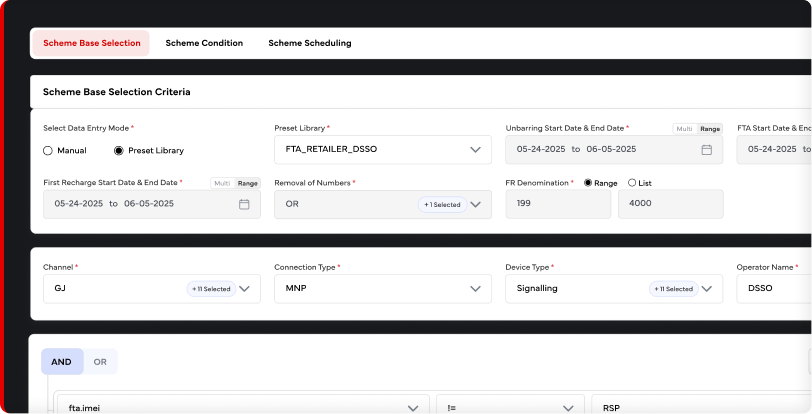
Filtering eligible transactions required writing custom SQL-like lookup queries or filtering 50k+ row spreadsheets by hand across date ranges, recharge amounts, MNP connection types, and device categories.
Created a visual filter matrix (Date Windows, FR Denomination Ranges, Connection/Device types) coupled with a 1-click Preset Library to load high-frequency eligibility profiles instantly.
Reduced base setup time by 85%; completely eliminated human miscalculation in target retailer inclusion/exclusion lists.
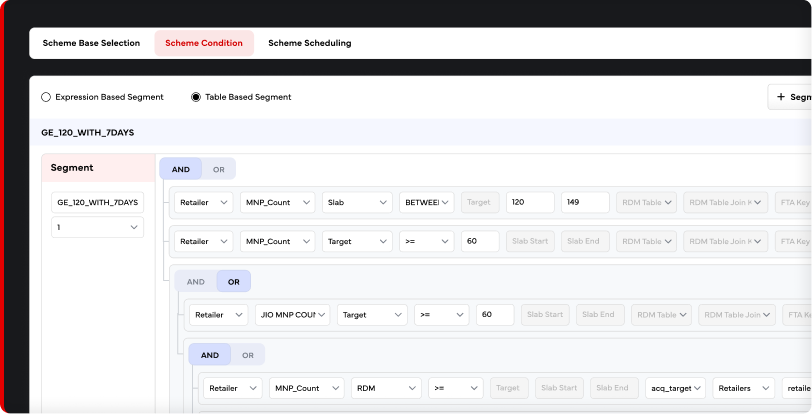
Formula logic was buried in deeply nested Excel formulas (`IF(AND(OR...))`). When contractors qualified for multiple payout tiers, priority conflicts were resolved manually, causing frequent payout disputes.
Engineered a table-based expression builder. Operators visually build segment conditions (`Field → Operator → Value`) and assign explicit priority tiers (Segment 1, 2, 3...) to automatically resolve overlaps.
Decreased expression configuration errors by 92% while providing transparent, deterministic execution across complex multi-tiered schemes.
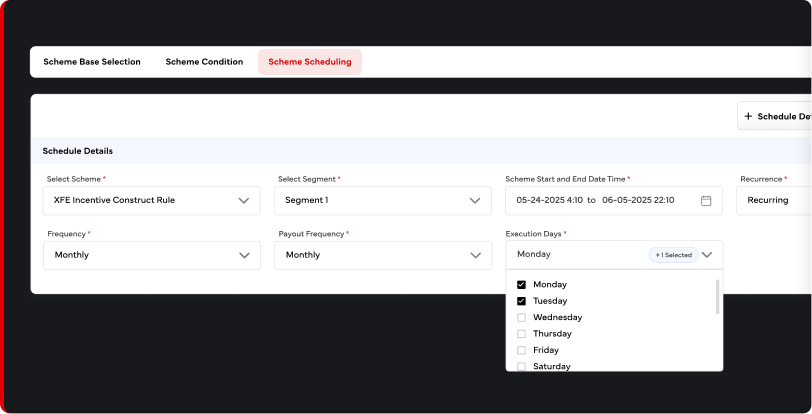
Disbursements relied on offline calendars and manual batch trigger scripts on specific cutoff days, frequently leading to delayed payments during month-end operational bottlenecks.
Integrated a segment-level cron scheduler into the workflow. Operators configure execution days, calculation frequency (Daily/Weekly/Monthly), and payout dates directly within the setup flow.
Automated 100% of disbursement triggers post-approval; reduced cycle execution latency from days to zero manual intervention.
Beyond Scheme Creation: The Operational Modules
2. Reference Data Upload
Operations teams still rely on Excel files for master contractor data, product catalogues, and raw transaction logs. We built a structured ingestion wizard that validates spreadsheet schemas, flags column mismatches, and prevents corrupted data imports.
3. Variable Creation Engine
Instead of hardcoding values inside spreadsheets, operators can select table columns, apply reusable Rule Collections, and define global functional logic for payout calculations.
4. Preset Library System
Setting up base filtration repeatedly was a major source of operator fatigue. The Preset Library allows complex eligibility rules (e.g., "AP Circle 4G Device Base") to be saved once and applied in one click.
5. Workflow Configurator
Created template builders so operational administrators can pre-configure scheme creation steps for different regional business units, standardizing how new payouts are defined.
6. User Access Management
Replaced open spreadsheet sharing with strict, role-based access control (RBAC). Admin, Creator, and Approver levels ensure operators only modify parameters relevant to their circle.
7. Request & Approval Management
Completely eliminated email tag games. Newly built schemes auto-generate approval requests sent directly to assigned managers with live audit status tracking and one-click sign-offs.
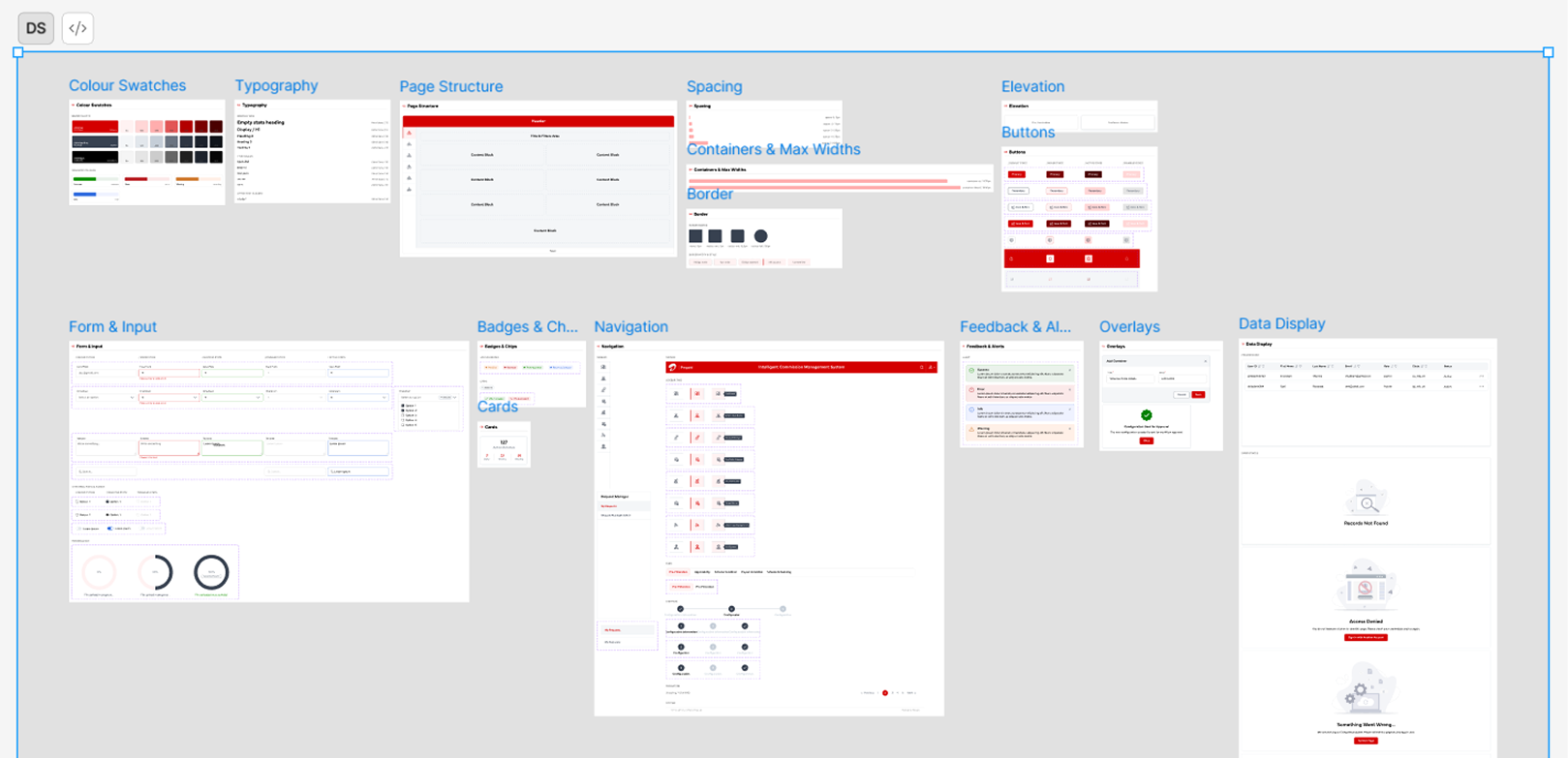
Figma Enterprise Design System
A bespoke, high-density component library tailored specifically for Airtel's desktop enterprise environment.
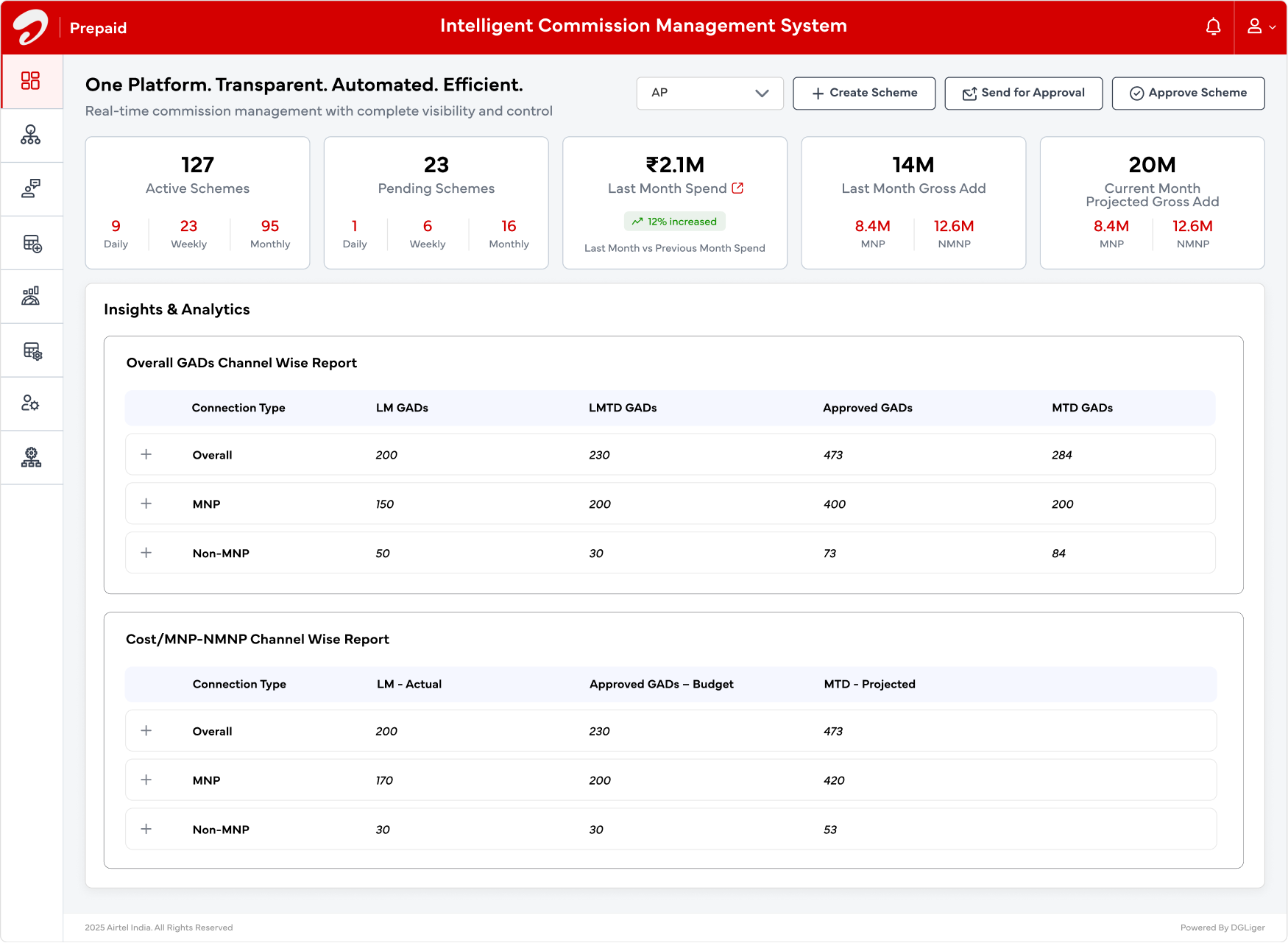
The Airtel ICMS Dashboard
Operational Results
"Designing ICMS proved that productizing complex legacy spreadsheets isn’t about changing user behavior entirely—it’s about giving familiar formulas a reliable, transparent structure."
By focusing on user interventions rather than screen count, we succeeded in transforming a high-stress month-end crunch into a predictable, automated background process for Airtel's operations team.
Future Scope & Interaction Evolution
While V1 successfully digitizes and standardizes complex operational rules, telemetry and direct operator usage reveal significant opportunity for visual compression. Given further iteration cycles, the system can transition from an explicit form configuration model to an intent-driven automated workflow engine.
1-Click Predictive Scheme Generation
By analyzing regional deployment history, the engine could automatically pre-fill Steps A through D based on scheme intent (e.g., "Q3 Retailer Churn Mitigation"), compressing a 12-click setup into a single review-and-confirm action.
Dynamic Expression Synthesis
Replace table-based condition builders with natural-language prompt synthesis or auto-suggested variable combinations inferred directly from historical top-performing regional schemes.
Smart Risk-Based Approval Routing
Bypass multi-tier static sign-offs by implementing automated approval thresholds based on total financial liability exposure and historical operator error scores.